Immersive learning makes use of technologies like virtual reality
(VR), augmented reality (AR), and mixed reality (MR) in order to aid learning.
To foster a sense of participation and immersion in the learning process, it
models real-world circumstances. Because the learner's interactions with
virtual items closely resemble those in the real world, they provide a safe
setting in which they are free to make (and learn through) mistakes without
risking their safety in the real world. Immersive
learning environments based on games have the ability to address
challenging teaching issues since they are a new learning platform.
The potential for combining game-based learning techniques with
Virtual Reality (VR) settings to enhance training and learning approaches is
quite promising. Students are immersed in a virtual debate as part of immersive
learning, and this sensation of presence is utilized as evidence that they are
interested in what they are studying. In order to make the player feel more
authentic to the role they are playing, video games that immerse users in an
alternate reality use a variety of techniques. Children who play games with
state-of-the-art visuals learn in an immersive gaming environment
and manage to blend fluid game play, fully realized narrative, and a high
degree of realism.
The 21st century skills are crucial for kids to learn since they
encourage "Lifelong Learning" in addition to making them more
employable. The most adaptable people are those that enjoy learning new things,
and history has proven that the most adaptable creatures are the ones that live
and flourish. The 21st century marked the beginning of the Digital Age, which
was defined by previously unheard-of technical development and the consequent
boom of information. The goal of AR learning is to increase student interest in
STEM courses, spark curiosity in STEM-related education and careers, and
improve teamwork skills.
Today, programmes like STEM education are vital to assist children
acquire these talents since STEM sectors increasingly require qualities like
thinking, producing, questioning, and creativity. The STEM curriculum includes
the "four C's" of 21st century STEM skills:
creativity, critical thinking, collaboration, and communication. Students work
together to develop unique solutions to current problems and then present their
solutions to others.
- Creativity
and Innovation
- Both
include the process of creating fresh ways of thinking to handle problems
as they arise and create original products and services.
- Critical Thinking and Problem Solving - Applying
higher order thinking to new problems and challenges, using sound logic as
they carefully consider the problem and decide on the best course of
action for overcoming it.
- Communication - The skill of
successful information exchange using a variety of media and technologies
in a wide range of circumstances and contexts is known as communicating.
- Collaboration - It is the
act of producing, applying, and collaborating with others on innovations,
solutions, and information in a respectful and beneficial way.
Wizar Learning aims to reimagine the
direction of education by providing a link to the Metaverse of Learning. It
reimagines the kind of instruction that will provide K–8 kids the information
they need to master the 21st century
STEM skills. Learning has been gamified and made immersive. By educating
children about the science behind commonplace objects, supporting them in
understanding how things work, and exposing them to the joy and satisfaction of
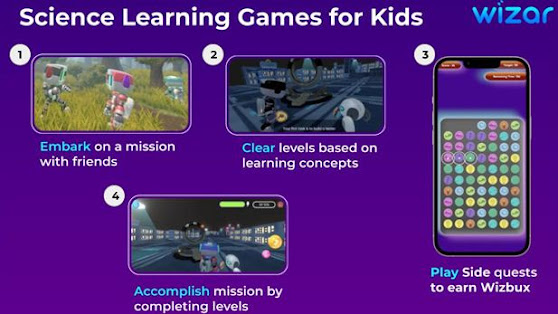
creating new things, they foster children's innate curiosity. Wizar Learning has arrived to offer stimulating games and tests that
follow the principle of gamification in STEM subjects and are in line with
curricula. Children can play immersive games, interact with others, invite
friends, personalize their Avatars, buy things, and level up by earning Wizbux
in augmented reality games for experiential learning.
Conclusion
The term "STEM education" refers to the integration of
the fields of science, mathematics, technology, and engineering. It is now
crucial to build the abilities that these fields' incorporation into STEM
education will lead to. By utilizing the appropriate technology tools to
complete their work, students will learn the most effective and efficient ways
to obtain and manage the vast amount of digital information that is available
to them. "Digital natives" like STEM classrooms because they are
welcoming, engaging environments that value their desire to actively engage in
their study.


Comments
Post a Comment